
Dunbar Directory Collections by Year
The Dunbar directory trail is not a stand-alone shelf labeled only for the city. The strongest verified run is Kanawha County Public Library’s Charleston metropolitan collection, which includes neighboring suburbs. Two exact federal microfilm years name Dunbar directly. Newspapers, census schedules and maps are companion collections rather than substitutes for a directory listing.
| Collection | Verified years | Where held | Access |
|---|---|---|---|
| Polk’s Charleston City Directories | 1908 to present; exact Dunbar years unlisted | KCPL Main Library, third floor | In person; no checkout or hold |
| NARA Charleston directories | 1928 and 1930 include Dunbar | NARA microfilm collection and partners | Research-facility or microfilm access |
| Dunbar Advance newspaper | Selected runs from 1917 through 1940 | West Virginia State Archives | Microfilm room or written request |
| Federal Census | Public schedules through 1950 | National Archives and access partners | Online or research-facility access |
| Dunbar Sanborn map | September 1933, nine sheets | Library of Congress | Free digital record |
The phrase “1908–Present” belongs to the library’s collection description. It does not mean every year survives or that Dunbar appears in every volume. Verify the needed year before traveling, and keep the complete volume title because the suburb can be filed inside a broader Charleston directory.
View Dunbar Directories at KCPL
The Kanawha County Public Library collection page is the main access point for Polk’s Charleston directories. Its public description covers personal and business addresses for Charleston and neighboring suburbs from 1908 to the present. Dunbar fits that metropolitan scope, but the page does not publish a year-by-year suburb inventory, shelf number or complete list of publisher changes.
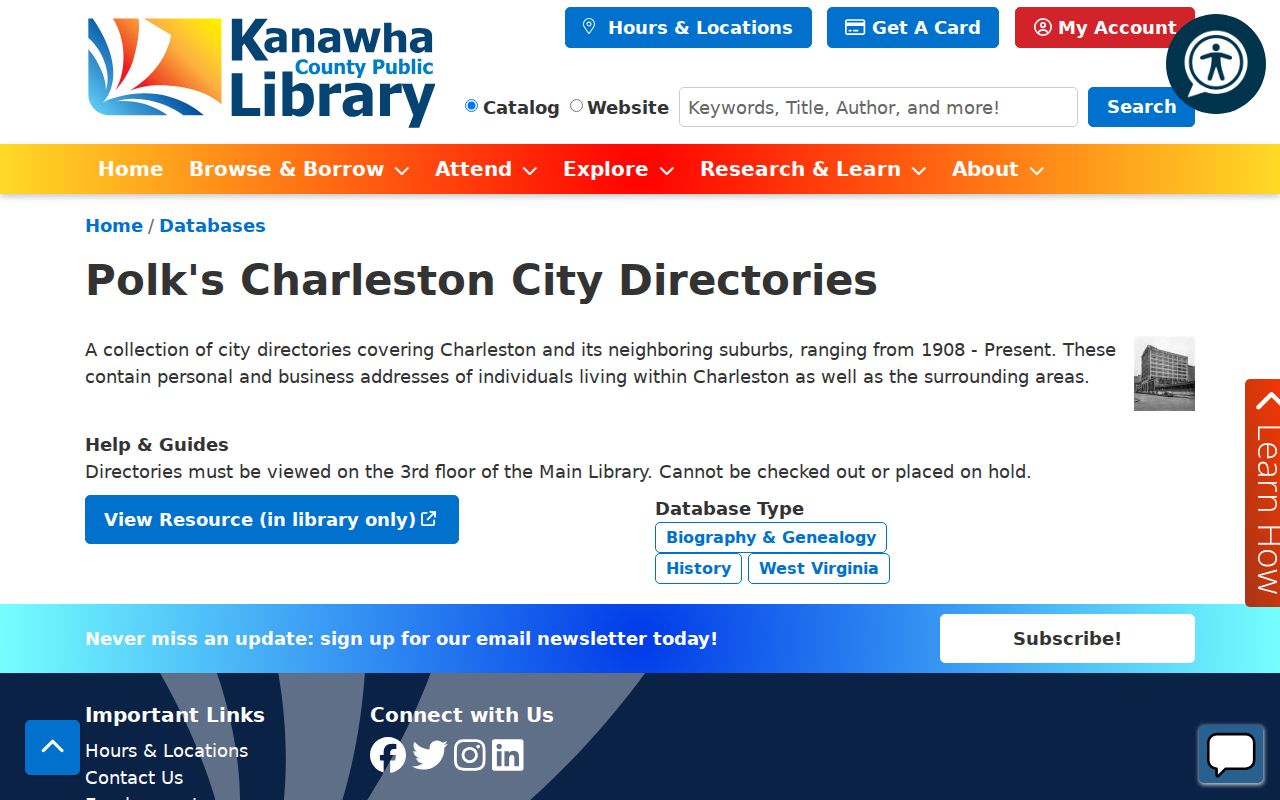
The capture shows the official collection entry and its access rule. Use the resource on the third floor of KCPL’s Main Library. It cannot be checked out or placed on hold.
Dunbar Public Library at 301 12th Street Mall is the local referral desk. Call 304-766-7161 to ask where to begin, then confirm Main Library access with KCPL staff. A focused question works best: give the surname, likely year, Dunbar address and whether a street-order or reverse section is needed. Staff may be able to confirm a volume before a visit, but the public page does not promise remote entry research.
Dunbar Directory Microfilm Years
The National Archives city-directory page supplies two firm year anchors. Its Charleston directory microfilm for 1928 and 1930 includes Dunbar, Kanawha City, St. Albans and South Charleston. That wording confirms a combined metro volume. It also explains why a search limited to a Dunbar-only title can miss the right book.
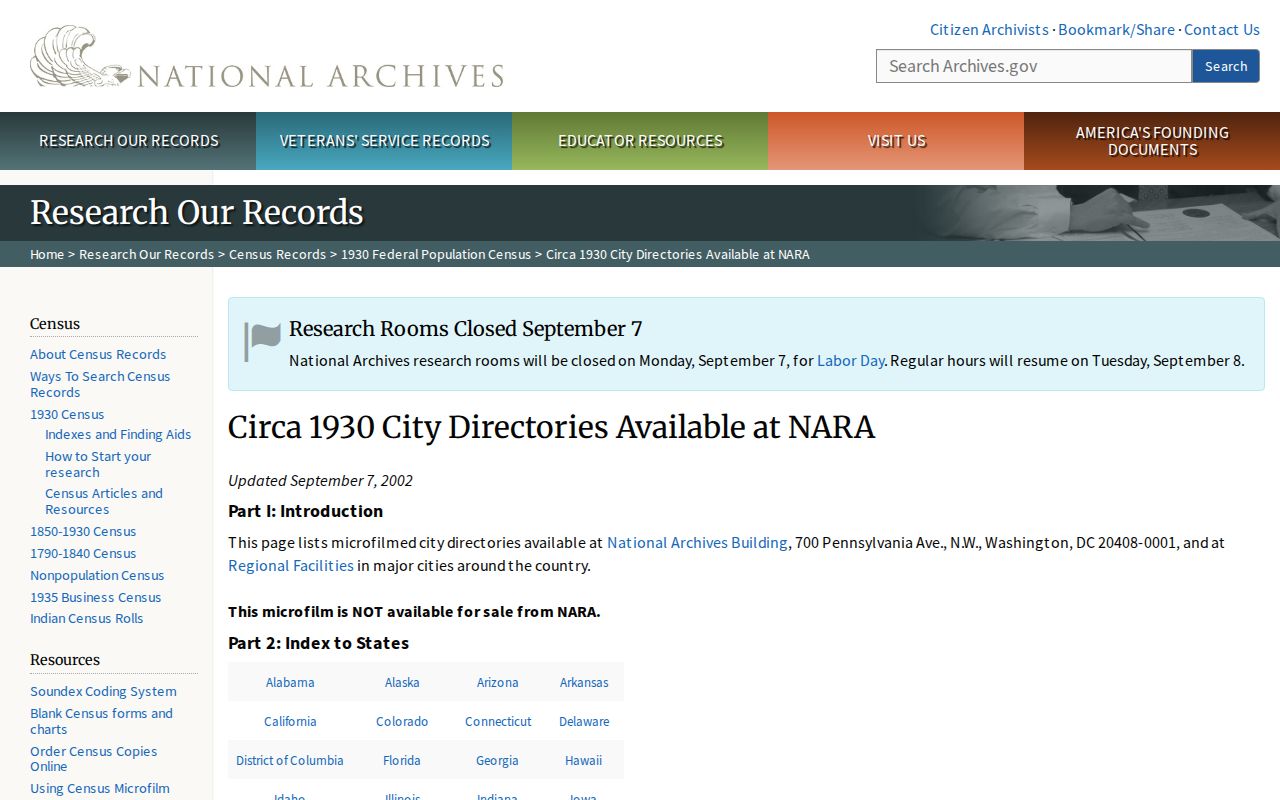
This NARA record verifies the two years and included places. It does not show a sample Dunbar page, a full annual run or a publisher for every volume.
Use the NARA years as fixed points. A 1930 entry can be compared with the 1930 Census for a household and with the 1933 Sanborn map for the building and street setting. Each source has a different purpose. The directory shows who was listed, the Census records one enumeration date, and the map shows physical features rather than ordinary resident names.
Decode a Dunbar Directory Entry
No individual Dunbar entry was visible in the public capture. That gap matters. Do not assume that a symbol means owner, renter, widow, residence or boarder until the volume’s own key says so. A sound directory note copies the entry exactly, photographs or transcribes the abbreviation key, and separates printed facts from later interpretation.
| Name as printed | Copy surname, given name, initials and punctuation without expanding them. |
|---|---|
| Street line | Record house number, street spelling and any city or suburb heading. |
| Household notation | Capture a spouse or other mark only when the entry and key visibly support it. |
| Business or role | Write down the printed work or business text without treating it as a home address. |
| Source citation | Keep the volume title, publisher, year, page and image or roll identifier. |
Three related terms often appear in catalog descriptions or inside a volume:
- Criss-cross directory
- A section organized by street address rather than surname. Its presence in a specific Dunbar volume must be confirmed on site.
- Householder index
- An address or household-based list that may identify a primary listed person. It is not proof of everyone in the home.
- Abbreviation key
- The volume’s own legend for short forms and symbols. It controls how marks in that edition should be read.
Trace Dunbar Families Across Directories
A directory works best as a dated link in a longer family trail. Start from a name or known address, preserve the printed form, and test nearby years. Do not turn one listing into continuous residence. A person can be missing because of a move, death, publication gap, changed initials or simple omission.
- Find the Dunbar heading or suburb section, then search the surname, first-name initial, middle initial and common abbreviated forms.
- Copy the year, page, exact street spelling, house number and every supported household or business notation.
- Search the prior and next available volumes. Mark a gap as “not found” rather than assuming the person left Dunbar.
- Pair the listing with the 1930 or 1950 Census when the dates fit. Federal population schedules are currently public through 1950 under the 72-year rule.
- Check a deed, assessment card, Dunbar Advance item or obituary to learn whether the listed person owned, occupied, visited or did business at the address.
For a current parcel and owner trail, use the Dunbar street directory workflow. It explains how the assessor’s situs, mailing and deed fields differ from a historical household listing.
Note: A directory disappearance can signal several events, so test both adjacent years and one independent dated source before drawing a conclusion.
Dunbar Advance Fills Directory Gaps
The West Virginia State Archives lists four discontinuous Dunbar Advance microfilm runs: June 22, 1917 through December 26, 1919; January 7 through December 30, 1921; January 27, 1927 through October 30, 1931; and October 15, 1937 through November 14, 1940. These periods bracket Dunbar’s early civic history and overlap the NARA directory years.
Search the same surname, street spelling and business name found in a historical volume. Property notices, obituaries, club news, council reports and advertisements can explain a change between volumes. Early industry names such as Gravely Tractor, Dunbar Flint Glass and Fletcher Enamel are useful search terms when a directory entry names a work role, but the industry name alone does not verify the person or address.
Missing newspaper dates must stay visible. When an issue falls outside the verified Dunbar Advance runs, try Charleston-area newspapers or ask Archives staff about nearby titles. Do not imply an unbroken local run.
Check Dunbar Listings Against Maps
The September 1933 Library of Congress Sanborn record contains nine sheets for Dunbar. A sheet may show the street grid, building footprint, construction material and labeled civic or business uses. It usually will not name a private resident. Use it to test whether the address and structure existed in that form near a directory year, not to supply a household.
City labels need the same care. Dunbar city, the separate West Dunbar Census-designated place, Kanawha County and the 25064 postal area are distinct geographies. Older metropolitan directories may file a place under a Charleston-area heading. Preserve the label as printed, then use Census geography or an assessor map to determine which boundary the source meant.
The 1921 municipal charter gave Dunbar council power to name and change streets and regulate house numbering. It does not prove a specific renumbering occurred. If an old street number resists a modern match, ask the City Clerk for ordinances, minutes, plats and maps before altering the historical entry.
Dunbar Directory Research Timeline
A short timeline keeps the verified dates in order without turning them into a claim of annual coverage:
| Year | Dunbar directory or records milestone |
|---|---|
| 1908 | Start of KCPL’s stated Charleston city-directory collection range. |
| 1919 | Dunbar was laid out by the Dunbar Development Company. |
| 1921 | Dunbar incorporated; its charter authorized street naming and numbering. |
| 1928 | NARA’s Charleston directory microfilm explicitly includes Dunbar. |
| 1930 | A second NARA Charleston directory year includes Dunbar and pairs with the federal Census. |
| 1933 | The nine-sheet Dunbar Sanborn set recorded physical street and building context. |
| 1950 | Newest federal population schedule open to the public under the 72-year rule. |
The final printed year and any publisher transitions were not available on the public KCPL page. Ask library staff for the actual shelf or database inventory before naming them.
Dunbar Historical Records at Archives
When a directory ends, the West Virginia State Archives Kanawha page becomes the county finding-aid route. It points to land, court, vital, newspaper, map and manuscript holdings. The Archives is the verified substitute for a historical-society collection because research did not locate a current official Kanawha historical-society holdings page.
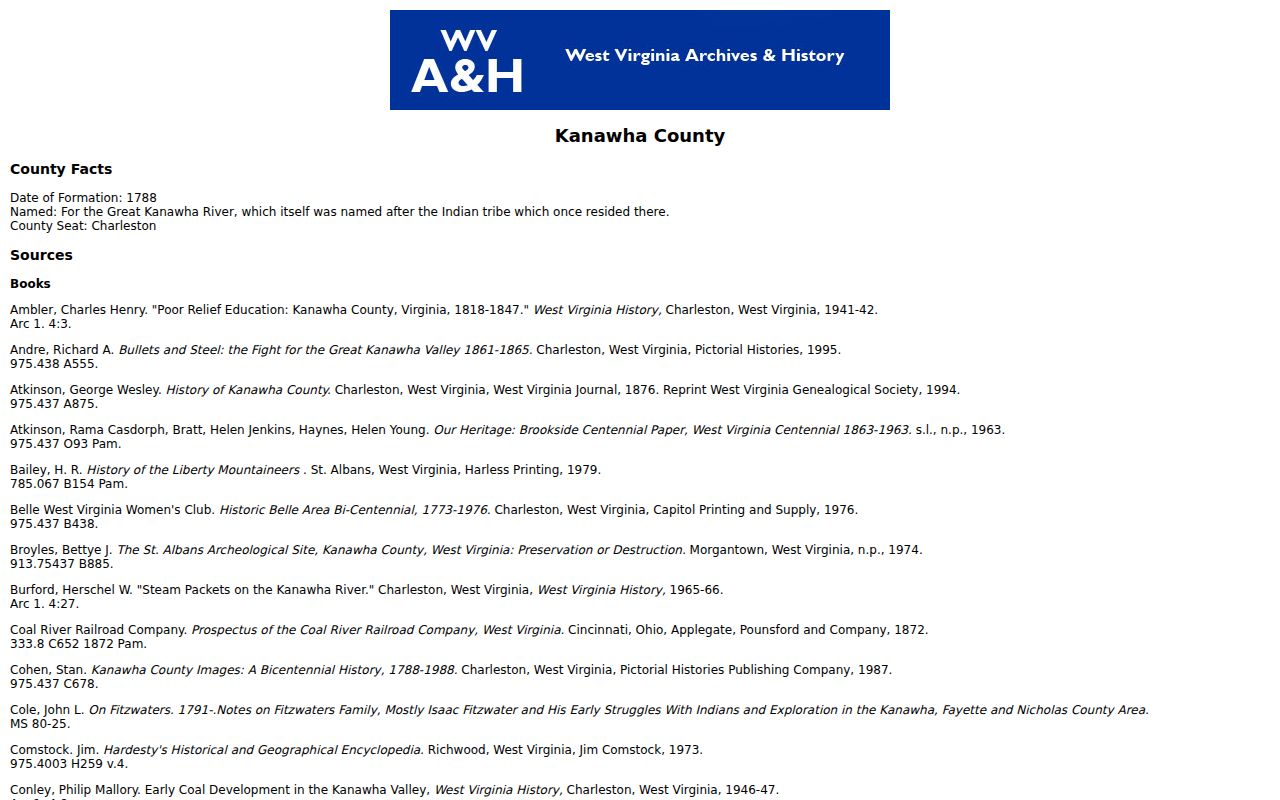
This page helps identify the record series to request after library or online searching stops. It does not guarantee a surviving Dunbar entry in every listed range.
The Archives research room is at the Culture Center in Charleston and is listed as open Tuesday through Saturday from 9 a.m. to 5 p.m. Staff accept written research requests and do not conduct research by phone or email. Standard copies are 25 cents per page, larger copies and reader prints have separate fees, and limited written research costs $10 for West Virginia residents or $20 for out-of-state requests. Newspaper and land-copy requests have their own listed charges. Give a name, year, record series and page or roll when known.
Limits of Dunbar Historical Directories
A Dunbar directory is a printed snapshot, not a legal finding of residence. It may omit a person, abbreviate a name, carry an old street label or list a business address. The library’s 1908-to-present description does not establish an uninterrupted Dunbar run. NARA’s two confirmed years do not fill every gap. Even a criss-cross section, when present, identifies the listed entry rather than all household members.
Keep each conclusion tied to the source’s purpose. A directory says who was listed at an address. A deed says who held a recorded interest. An assessor card gives an assessment snapshot. A census captures one enumeration date. An obituary or newspaper notice reports a dated event. Agreement among two or more of those records is far stronger than repeating one directory entry.
Best practice. Preserve the exact printed name, street, year and page, then label any later match as an interpretation until another dated source agrees.